





CH
Chris Heilmann
World Congress 2022
•
Jun 15, 2022
Can CSS recreate Tufte's designs?
Håkon Wium Lie
- Discuss this with your agent
- Open in Claude
- Open in ChatGPT
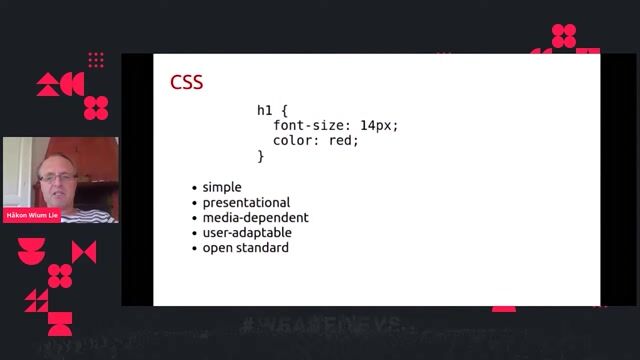
Can modern CSS replace InDesign for high-end print publishing? Discover how to programmatically recreate Edward Tufte’s famously complex book layouts using just HTML and CSS.
Matching moments
3:31 min
Applying CSS techniques to printed book typography
Håkon Wium Lie · World Congress 2021
3:05 min
Formatting physical books and the aesthetic impact of CSS
Håkon Wium Lie · World Congress 2021
58 sec
Formatting printable documents with page media CSS
 Chris Heilmann +2 · LIVE
9:28 min
Audience questions on design control and printed CSS standards
Håkon Wium Lie · World Congress 2021
2:04 min
Introduction to modern CSS capabilities for designers
Onur Gumus · LIVE
2:55 min
Evaluating the future utility of CSS Houdini web standards
Tanja Ulianova · World Congress 2023
More from World Congress 2022
Related videos
Related articles

DC
Daniel Cranney

DC
Daniel Cranney
LM
Luis Minvielle
.webp)
From learning to earning
Jobs that call for the skills explored in this talk.
1 day ago
Senior Fullstack Engineer - Hybrid or Remote

Edge Impulse
Cambridge, UK
Expert
£63k–98k
Remote
Redis
Node.Js
PostgreSQL
1 day ago
Senior Fullstack Engineer - Hybrid or Remote
Edge Impulse
York, UK
Expert
£63k–98k
Remote
Redis
Node.Js
PostgreSQL
1 day ago
Remote Senior Full-Stack Engineer
Edge Impulse
Stockbridge, UK
Expert
£63k–98k
Remote
Redis
Docker
Datadog
1 day ago
Senior Fullstack Engineer - Hybrid or Remote
Edge Impulse
Leicester, UK
Expert
£63k–98k
Remote
Redis
Node.Js
PostgreSQL
1 day ago
Senior Fullstack Engineer - Hybrid or Remote
Edge Impulse
Ferndown, UK
Expert
£63k–98k
Remote
Redis
Node.Js
PostgreSQL
1 day ago
Senior Fullstack Engineer - Hybrid or Remote
Edge Impulse
Falkirk, UK
Expert
£63k–98k
Remote
Redis
Node.Js
PostgreSQL