

WeAreDevelopers LIVE May 12, 2023

How to Fail Successfully

Eleanor Rumsey

Eleanor Ramsey reveals why failing successfully is a junior developer's greatest asset. Discover how to conquer imposter syndrome and transform technical mistakes into rapid career growth.

Pause
Mute Enter Fullscreen
#1 about 2 min

Recognizing imposter syndrome during the intern experience

Experiencing emotional obstacles and doubting personal qualifications is a common reality when joining a new software company.

#2 about 2 min

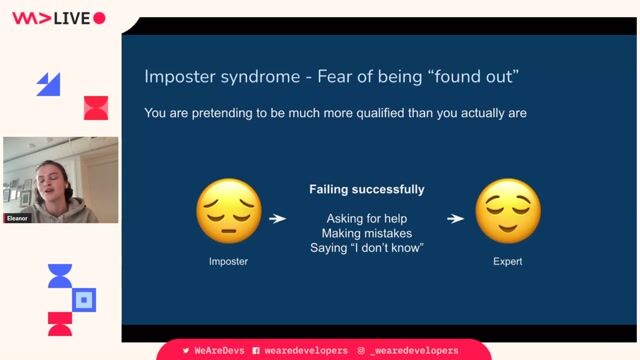
Defining imposter syndrome and the fear of exposure

Understanding that the apprehension toward asking for help stems from a deep fear of being uncovered as underqualified.

#3 about 3 min

Navigating new technologies and narrowed tech stack confidence

Overcoming professional doubt when shifting from familiar back-end concepts to unfamiliar front-end frameworks.

#4 about 4 min

Designing meaningful software projects for specific intern growth

Assigning low-urgency, high-importance engineering tasks prevents team isolation and reinforces technical skill development over meaningless assignments.

#5 about 8 min

Asking for help framed by existing technical knowledge

Requesting assistance by explicitly stating the known parameters of a problem accelerates debugging and builds personal confidence.

#6 about 5 min

Mitigating developer mistakes without a culture of blame

Addressing coding errors transparently and utilizing standard safety processes like code reviews naturally prevents catastrophic bugs.

#7 about 6 min

Redefining limits of knowledge and receiving code feedback

Using transparent communication about what is unknown converts perceived failure into rapid technical growth during code reviews.

#8 about 4 min

Trusting personal analytical skills against strong technical opinions

Gaining confidence to challenge incorrect code patterns or strongly opinionated engineers by firmly recalling independent design decisions.

#9 about 4 min

Diverse management representation and underrepresented groups in tech

Seeing diverse engineering leadership provides critical support for overcoming deep-seated self-doubt among underrepresented technical professionals.

#10 about 4 min

Expanding skills naturally toward full stack software development

Exploring multiple back-end and front-end languages with genuine curiosity slowly develops natural competence across complex applications.

#11 about 2 min

Modifying testing code to navigate new software codebases

Exploring an unfamiliar software project by directly altering testing features builds practical understanding of system components.

#12 about 3 min

Promoting a culturally safe environment for technical innovation

Supporting high-risk innovation and learning from failure requires engineering management to champion solutions through blameless frameworks.

#13 about 3 min

Transitioning into software engineering roles from nontechnical fields

Exploring self-directed learning paths like independent programming projects aids highly effective career shifts into software development.

#14 about 10 min

Navigating technical interviews by prioritizing interpersonal communication skills

Reducing application anxiety requires viewing technical interviews as mutual conversations about team fit rather than intense technical interrogations.

#15 about 6 min

Combating new developer anxiety through explicit transparency expectations

Supporting overwhelmed new developers involves continuously communicating that learning takes considerable time and expecting clarifying operational questions.

Matching moments

3:02 min

Managing developer imposter syndrome with just-in-time learning strategies

Chris Ferdinandi · JS Congress

1:47 min

Overcoming imposter syndrome without immediate representation in tech communities

Anna Leushchenko Anna Leushchenko · LIVE

1:20 min

Identifying and breaking down professional workplace fears

Meghan Hennessy Meghan Hennessy · World Congress 2025

2:08 min

Navigating and mitigating the impacts of broken engineering cultures

Oskar Kruschitz Oskar Kruschitz · Europe 2026 Virtual

1:06 min

Overcoming imposter syndrome and feelings of isolation in engineering

Adela Georgescu Adela Georgescu · Europe 2026 Virtual

4:01 min

Reframing imposter syndrome and cognitive dissonance in tech

Jo Franchetti Jo Franchetti · LIVE

Upcoming sessions on this topic

Open session

World Congress 2026 North America

September 25, 2026 · 15:30–16:00

Stage 4

Evals Are Infra: Building AI Systems Developers Can Actually Trust

Phoebe Wang

Member of Technical Staff at OpenAI

Phoebe Wang
Open session

World Congress 2026 North America

September 25, 2026 · 14:10–14:40

Outdoor Stage

Who Did the Work?

Beth Rudden

Runs Bast AI. Still writes the code.

Beth Rudden
Open session

World Congress 2026 North America

September 25, 2026 · 11:40–12:10

Stage 3

Culture Doesn't Scale Itself: Leading Engineering Teams Through Hypergrowth and the AI Transition

Thanos Baskous

VP of Engineering and Co-founder of Cogent Security

Thanos Baskous
Open session

World Congress 2026 North America

September 25, 2026 · 14:10–14:40

Stage 1

The Broken Rung: How AI is Rebuilding Software Development from the Ground Up

Tomislav Tipurić

Chief Technology Officer, Nephos

Tomislav Tipurić
Open session

World Congress 2026 North America

September 24, 2026 · 16:10–16:40

Outdoor Stage

When Humans Stop Writing Code: Rethinking Languages, Compilers, and Responsibility

Simon Auer

Organizer of flutter vienna meetup and CEO of marqably

Simon Auer
Open session

World Congress 2026 North America

September 25, 2026 · 14:50–15:20

Outdoor Stage

Your Brain Is Lying to You: Cognitive Biases in Development

Kate Astrid

Senior Product Engineer

Kate Astrid