
How do you build a chatbot that never hallucinates? Go beyond vector search by grounding your LLM in a knowledge graph for precise, controllable, and verifiable answers.
#1about 2 minutes
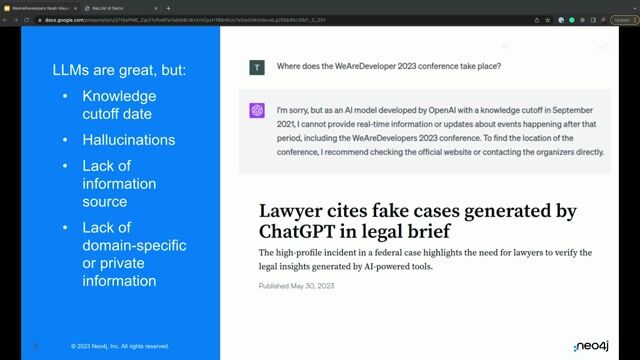
Understanding the limitations of large language models
Standard LLMs can hallucinate, lack up-to-date information, and cannot cite sources, making them unreliable for domain-specific tasks.
#2about 2 minutes
Introducing retrieval-augmented generation to improve accuracy
Retrieval-augmented generation (RAG) solves LLM limitations by providing relevant context from a knowledge base to ground the model's answers in facts.
#3about 2 minutes
Implementing RAG with vector similarity search on documents
Unstructured documents like PDFs are chunked, converted into vector embeddings, and stored in a vector database for similarity search against user queries.
#4about 5 minutes
Using knowledge graphs for precise, structured data retrieval
Knowledge graphs represent information as nodes and relationships, allowing an LLM to generate precise Cypher queries instead of relying on semantic search.
#5about 2 minutes
Answering complex multi-hop questions with graph queries
Knowledge graphs excel at answering multi-hop questions that require connecting multiple pieces of information, which is difficult for unstructured RAG systems.
#6about 2 minutes
Exploring real-world use cases for knowledge graphs
Knowledge graphs can power chatbots for various domains, including supply chain management, HR and skills mapping, and microservice architecture analysis.
#7about 1 minute
Building a hybrid chatbot with structured and unstructured data
A hybrid approach combines the benefits of both systems by connecting unstructured text chunks as nodes within a structured knowledge graph.
#8about 4 minutes
Demonstrating a chatbot powered by a knowledge graph
The live demo showcases a chatbot that answers questions by generating Cypher queries for structured data and summarizing connected unstructured articles.
#9about 2 minutes
Q&A on data pipelines and error handling
The Q&A covers methods for converting unstructured data into a knowledge graph using named entity extraction and how LLMs handle spelling mistakes in queries.
Related jobs
Jobs that call for the skills explored in this talk.

ChatGPT on AI Hallucinations: Can It Fix Its Own Mistakes?Most of us use AI daily—whether summarizing text, organizing tasks, suggesting recipes, or even translating languages in real time. As AI chatbots become more integrated into our lives, we increasingly rely on them for efficiency, inspiration, and pr...
Krissy Davis
The Best AI Chatbots: ChatGPT and Other AlternativesEveryone who uses the internet knows about ChatGPT, one of the most potent and one of the best, if not the best, AI chatbots on the market. This AI chatbot uses natural language processing technology to analyse and respond precisely as humans would d...
Krissy Davis
Is ChatGPT Getting Worse Over Time?OpenAI launched ChatGPT-3 at the end of 2022, and while most would agree that it's by far the best model available, a few people have been noticing a change in the output quality. Now, we want to preface this discussion by saying that ChatGPT is stil...
Michael Hunger, Neo4j
Graph and AI Trends 2026: Why Is AI Running but Not Yet Delivering?After a few intense years of building with AI, many teams are asking the same question: Where is the ROI?
We’re shipping chatbots, copilots, and agents . But:
Agents aren’t autonomous enough to own end‑to‑end workflows.
Model quality degrades over t...
From learning to earning
Jobs that call for the skills explored in this talk.