




Florian Rappl

Multiple Ships to the Island - Micro Frontends & Island Architectures

Stop choosing between micro frontends and islands architecture. This talk shows how to combine them for independent shipping and superior web performance.

Multiple Ships to the Island - Micro Frontends & Island Architectures
#1about 2 minutes

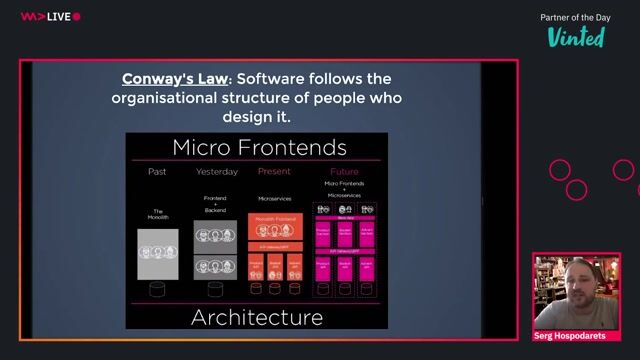
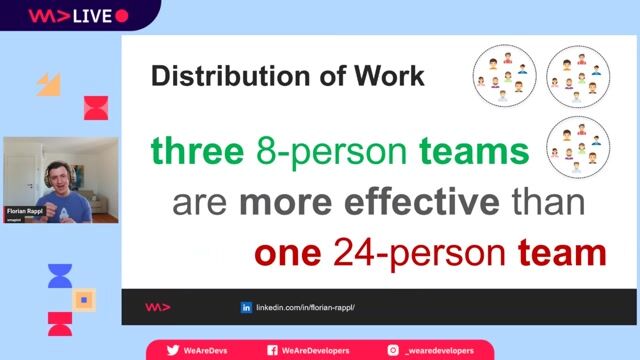
Micro frontends are an organizational pattern for scaling teams

Micro frontends enable development scaling by structuring work around small, autonomous "two-pizza teams" that require minimal alignment.

#2about 5 minutes

Exploring technical patterns for micro frontend composition

Several technical approaches can be used for composition, including the web approach with iframes, server-side composition, and client-side composition with web components.

#3about 3 minutes

Achieving independent deployment cycles for each team

The architecture allows teams to develop and deploy their micro frontends on their own schedules without needing to align with other teams.

#4about 3 minutes

Defining a micro frontend as a container for domain components

A micro frontend is best understood as a container for domain-specific components, which are enriched with business logic, rather than just a library of generic UI elements.

#5about 7 minutes

Demo of a client-side composed micro frontend application

A Netflix clone demonstrates how features managed by different micro frontends can be dynamically enabled or disabled using a discovery service.

#6about 6 minutes

Introducing islands architecture to reduce javascript payload

Islands architecture improves performance by server-rendering static HTML and only shipping JavaScript for interactive "islands," using either partial hydration or resumability.

#7about 8 minutes

Combining micro frontends with an islands architecture

By composing micro frontends on the server and using resumability, you can achieve both scalable development and high-performance, zero-JavaScript-by-default user experiences.

#8about 10 minutes

Demo of a server-rendered micro frontend application

A revised Netflix clone shows how the combined architecture enables a fast, server-rendered experience that works without JavaScript while retaining development autonomy.

#9about 14 minutes

Q&A on practical implementation and impact

The Q&A covers common examples like iframes for ads, the positive impact on SEO, local development strategies, and the performance trade-offs of using multiple frameworks.

Related jobs
Jobs that call for the skills explored in this talk.

Featured Partners

Related Articles

View all articles
BR
Benjamin Ruschin
What Developers Really Need to Create Great Code Demos
Every developer on earth has, at some point, had another developer to thank for a breakthrough, a success, an aha moment they wouldn’t have had without coming across that blog post, that open-source contribution, that reply on socials or that humble ...
What Developers Really Need to Create Great Code Demos
CH
Chris Heilmann
WeAreDevelopers LIVE days are changing - get ready to take part
Starting with this week's Web Dev Day edition of WeAreDevelopers LIVE Days, we changed the the way we run these online conferences. The main differences are:Shorter talks (half an hour tops)More interaction in Q&AA tips and tricks "Did you know" sect...
WeAreDevelopers LIVE days are changing - get ready to take part
BB
Benedikt Bischof
Why You Shouldn’t Build a Microservice Architecture
Welcome to this issue of the WeAreDevelopers Live Talk series. This article recaps an interesting talk by Michael Eisenbart who talks about the pros and cons of microservice architecture.‍About the speaker:‍Michael has been working for Bosch as a sof...
Why You Shouldn’t Build a Microservice Architecture

From learning to earning

Jobs that call for the skills explored in this talk.