

Typed Security: Preventing Vulnerabilities By Design
What if your type system could be your best security tool? Learn how to encode security rules into types, making entire classes of vulnerabilities simply impossible.
#1about 3 minutes
Introduction to domain-driven design principles
Domain-driven design (DDD) helps structure code to match the business domain by using concepts like entities, value objects, and aggregates.
#2about 4 minutes
Making illegal states unrepresentable with types
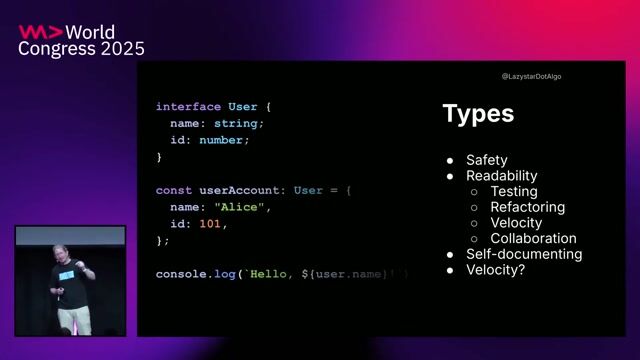
By designing data types so that invalid combinations cannot be expressed, the compiler can prevent bugs and enforce business rules automatically.
#3about 3 minutes
Avoiding null pointer exceptions with optionals
Using the `Optional` type in languages like Java explicitly models the potential absence of a value, forcing developers to handle empty cases.
#4about 2 minutes
Overcoming primitive obsession with custom types
Wrapping primitive types like strings and integers in custom types (e.g., `UserId`) prevents logical errors like mixing up different kinds of IDs.
#5about 9 minutes
Modeling a business workflow with rich types
An email verification process is modeled using smart constructors and sum types, replacing a simple boolean flag to guarantee correctness.
#6about 2 minutes
Applying typed security to OWASP vulnerabilities
Type systems can be used to systematically prevent common security flaws listed in the OWASP Top 10, such as injection and access control issues.
#7about 7 minutes
Using types as authorization tokens
Replacing boolean authorization checks with type-based access tokens ensures that protected functions can only be called after a successful permission check.
#8about 2 minutes
Preventing SQL injection with a query type
Differentiating between a raw string and a dedicated `Query` type at the compiler level prevents accidental string concatenation and forces safe data handling.
#9about 4 minutes
Preventing data leaks with data transfer objects
Data Transfer Objects (DTOs) act as a boundary layer, exposing only necessary and safe data to external clients while protecting sensitive internal models.
#10about 2 minutes
Eliminating XSS with a dedicated HTML type
In frameworks like Elm, treating HTML as a distinct type ensures that all string inputs are automatically sanitized, preventing cross-site scripting attacks.
#11about 2 minutes
Structuring applications with clean architecture
Architectural patterns like Clean or Hexagonal Architecture isolate the pure business logic core from external dependencies, complementing a type-driven approach.
#12about 2 minutes
Key takeaways for building secure applications
The core principles for secure design are to make illegal states unrepresentable, parse instead of just validating, and use the compiler as a security tool.
#13about 17 minutes
Q&A on type systems and legacy code
The speaker answers audience questions about effective languages, limitations, frontend vs backend validation, and applying these concepts to legacy codebases.
Related jobs
Jobs that call for the skills explored in this talk.
Dev Digest 138 - Are you secure about this?Hello there! This is the 2nd "out of the can" edition of 3 as I am on vacation in Greece eating lovely things on the beach. So, fewer news, but lots of great resources. Many around the topic of security. Enjoy! News and ArticlesGoogle Pixel phones t...
Daniel Cranney
The Overflow: 5 Security and Privacy Tools for DevelopersWe’re back again with another edition of the Overflow, where we share some of the best tools we’ve found from around the web that we just couldn’t cram into the already jam-packed editions of the Dev Digest.
So let’s take a look at five security and ...
Why Developers are So Excited About PretextPretext is a new JavaScript and TypeScript library from Cheng Lou - previously a React core developer - that crossed 7,000 GitHub stars in three days to get the entire tech world talking recently.
The demos that spread were visually striking: dragon...
From learning to earning
Jobs that call for the skills explored in this talk.