
World Congress 2026 Europe Jul 9, 2026 Session details

Practical tips for keeping your C# code base clean

Dennis Doomen

Is your C# codebase slowly turning into a tangled, distributed monolith? Discover pragmatic habits and architectural tweaks to shed unnecessary complexity and reclaim your code's maintainability.

Pause
Mute Enter Fullscreen
#1 about 3 min

Establishing project guidelines and HTTP logging standards

Documenting source control decisions and defining strict HTTP endpoint behaviors prevents future troubleshooting pain in production environments.

#2 about 2 min

Improving and maintaining AI prompts for code generation

Treating AI prompts as reusable skills and continuously refining them based on manual feedback ensures generated code remains human-maintainable.

#3 about 2 min

Evaluating microservices and managing package dependencies

Merging overly distributed microservices into a modular monolith and structuring packages to minimize ripple effects solves common diamond dependency problems.

#4 about 3 min

Simplifying solution structures and splitting shared projects

Consolidating projects that deploy together and splitting overly generic shared modules reduces unnecessary coupling in large codebases.

#5 about 1 min

Adopting functional folder structures for screaming architecture

Organizing folder structures by functional features rather than technical layers allows developers to instantly grasp the underlying domain architecture.

#6 about 2 min

Making classes internal by default to safely delete code

Restricting access modifiers to internal allows modern IDEs and AI tools to easily identify and confidently remove unused code.

#7 about 2 min

Writing contextual documentation for self-explanatory code limits

Adding functional comments that explain the reasoning and context behind complex logic prevents confusion for future maintainers.

#8 about 3 min

Structuring and shortening test names for readability

Grouping unit tests with nested classes and using concise, fact-based names makes pull requests and expected behavior easier to review.

#9 about 2 min

Localizing dependency injection registrations in functional modules

Grouping dependency injection registrations into extension methods within their respective functional folders prevents the root application container from becoming unmanageable.

#10 about 2 min

Applying the scouting rule and splitting pull requests

Breaking large refactoring efforts into separate commits or pull requests ensures functional changes remain easy to review and approve.

#11 about 2 min

Adopting standard branching strategies and utilizing repository forks

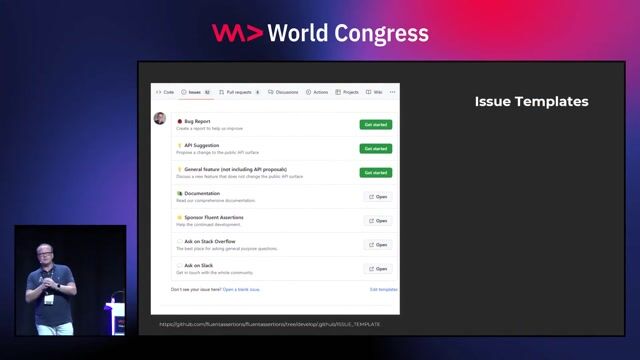
Moving feature branches to personal forks and adhering to established workflows like GitHub Flow keeps the main repository clean and understandable.

#12 about 2 min

Maintaining clean git histories with rebasing and fixup commits

Using interactive rebases and fixup commits avoids cluttered merge histories and enables efficient bug tracking through version control.

#13 about 2 min

Clarifying code review expectations with emoji indicators

Prefixing code review comments with specific emojis clarifies whether feedback is a strict requirement, a suggestion, or a minor nitpick.

Matching moments

1:29 min

Introduction to keeping test code clean

Gil Zilberfeld · LIVE

6:34 min

Defining the core principles of clean code

Gil Zilberfeld · LIVE

5:55 min

Evaluating generated code syntax and maintaining quality control

Phil Nash · Coffee With Developers

53 sec

Tackling code smells during routine peer code reviews

Benjamin Bischoff Benjamin Bischoff · WWC 2024

2:01 min

Combining refactoring techniques with best programming practices

Kamila Santos · LIVE

1:52 min

Balancing technical debt and clean code practices

Stefan Lingler Stefan Lingler +1 · Coffee With Developers

Upcoming sessions on this topic

Open session

World Congress 2026 North America

When Humans Stop Writing Code: Rethinking Languages, Compilers, and Responsibility

Simon Auer

Organizer of flutter vienna meetup and CEO of marqably

Simon Auer
Open session

World Congress 2026 North America

The spectrum of agentic coding: From vibe coding to high-quality software engineering

YK Sugi

Developer Experience Manager at Eventual

YK Sugi
Open session

World Congress 2026 North America

Merging at Scale: From Broken Builds to Green Mainline

Manjari Akella, Preetam Dwivedi

Manjari Akella
Preetam Dwivedi
Open session

World Congress 2026 North America

GitHub’s Team X-Ray: Your Repository Knows More About Your Team Than Your Team Does

Andrea Griffiths

Senior Developer Advocate

Andrea Griffiths
Open session

World Congress 2026 North America

Beyond Vibe Coding: Using CLI Tools as Your AI Counterpart in Pair Programming

Ron Veen

Java enthusiast and Special agent for Team Rockstars IT

Ron Veen
Open session

World Congress 2026 North America

Agentic Drift: keeping pace with your agents

John Coghlan

Senior Director, Developer Advocacy at GitLab

John Coghlan