
World Congress 2026 Europe Jul 10, 2026 Session details

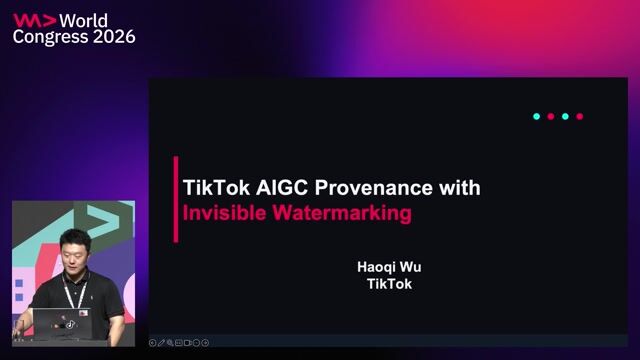
Robust AIGC Provenance with Invisible Watermarking

Haoqi Wu

Standard metadata disappears during content sharing. Misinformation thrives in this gap. Discover how TikTok uses invisible, ML-based watermarks to embed indestructible AI provenance directly into pixel layers.

Pause
Mute Enter Fullscreen
#1 about 3 min

Introduction to AIGC provenance and authenticity challenges

The explosive growth of AI-generated media makes distinguishing synthetic content from reality increasingly difficult for users.

#2 about 3 min

Establishing proactive provenance and platform safety responsibilities

Recognizing its own generative output enables a platform to swiftly manage misinformation and ensure trusted safety.

#3 about 3 min

Implementing C2PA metadata for generative AI transparency

Attaching cryptographic manifests and visible labels to native generations offers a publicly verifiable lineage standard.

#4 about 2 min

Why cryptographic metadata degrades during media distribution

File-level credentials often fail to survive across platform re-encodings, aggressive compression, and user-initiated edits.

#5 about 2 min

Complementing C2PA metadata with robust invisible watermarking

Embedding a resilient, machine-readable signal directly into content frames prevents data loss when metadata is stripped.

#6 about 2 min

End-to-end workflow for injecting a recoverable UUID

Generating, distributing, and ultimately extracting an embedded UUID establishes a dependable recovery path for the original provenance context.

#7 about 4 min

Evaluating techniques for embedding robust media signals

Compared to traditional frequency domain designs, a machine learning strategy best resists compounding real-world adversarial transformations.

#8 about 4 min

Architecture of machine learning-based watermark neural networks

Utilizing joint encoder-decoder training within a shared latent space conceals provenance data as an unnoticeable pixel residue.

#9 about 2 min

Balancing robustness, imperceptibility, and bit capacity constraints

Delivering a scalable production watermark requires navigating the inherent tension between signal durability, data payload, and visual quality.

#10 about 2 min

Achieving visual imperceptibility with specialized loss functions

Employing pixel, regional, and temporal loss equations minimizes visible artifacts without compromising the underlying embedded identifier.

#11 about 2 min

Training against media augmentations to preserve signal integrity

Exposing the neural network to diverse cropping, compression, and filtering permutations ensures the signal outlasts hostile processing.

#12 about 1 min

Closing the automated provenance loop in production systems

Integrating dual embedding logic transforms a fresh upload pipeline into a reliable automated detector of recycled synthetics.

#13 about 2 min

Future steps for cross-platform open authenticity standards

Expanding user-facing verification tools and fostering industry interoperability will sustain media authenticity across varied internet ecosystems.

#14 about 2 min

Defending against adversarial attacks and dynamic circumvention tactics

Continually updating embedding policies and extraction model strategies outpaces malicious attempts designed to destroy the digital fingerprint.

Matching moments

53 sec

Tracing content provenance with the C2PA standard

Jen Looper Jen Looper · Europe 2026 Virtual

3:58 min

Protecting intellectual property and content verification with blockchain

Brian Whippo Brian Whippo · Coffee With Developers

1:44 min

Addressing the authenticity of AI translated video content

Chris Heilmann +2 · LIVE

8:22 min

Regulating deepfake content and AI transparency in Europe

Chris Heilmann +2 · LIVE

2:52 min

Audience questions on deepfake detection, regulations, and ethics

Cheuk Ho · World Congress 2023

8:37 min

AI video generation tools and content creation challenges

Chris Heilmann +2 · LIVE

Upcoming sessions on this topic

Open session

World Congress 2026 North America

September 24, 2026 · 17:30–18:00

Stage 5

Securing AI Agent Infrastructure: Identity, Attestation, and Trust at Scale

Abdel Fane

Founder of OpenA2A

Abdel Fane
Open session

World Congress 2026 North America

September 24, 2026 · 11:40–12:10

Stage 2

The Private AI Platform: Why Agentic Apps Need a Private Application Platform

Oren Penso

Global field CTO, Tanzu division, Broadcom

Oren Penso
Open session

World Congress 2026 North America

September 24, 2026 · 12:15–12:45

Stage 6

AI vs. AI: Defending the open source supply chain with agentic workflows

Manfred Moser

Senior Principal DevRel Engineer at Chainguard

Manfred Moser
Open session

World Congress 2026 North America

September 23, 2026 · 10:00–17:00

Stage 11

Building Stuff with GenAI - The Open Minded Workshop beyond OpenAI

Andreas Erben

CTO for Applied AI and Metaverse at daenet

Andreas Erben
Open session

World Congress 2026 North America

September 25, 2026 · 15:30–16:00

Stage 7

Trust, But Verify: Continuous GPU Validation at Scale

Kyle Bell

VP of AI at TensorWave

Kyle Bell
Open session

World Congress 2026 North America

September 24, 2026 · 15:30–16:00

Outdoor Stage

From Boardroom to Build Pipeline: What AI Governance Actually Looks Like in Practice

Anita Ganti

Board Director & Technology Executive

Anita Ganti