


BB
Benedikt Bischof
World Congress 2023
•
Aug 11, 2023
Using WebAssembly to run, extend, and secure your application
- Discuss this with your agent
- Open in Claude
- Open in ChatGPT
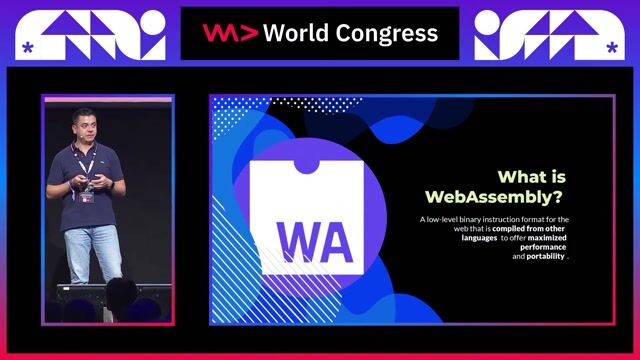
WebAssembly has outgrown the browser. It is now a powerhouse for backend security. Learn how WASI sandboxing neutralizes supply chain threats in your cloud-native apps.
Matching moments
1:32 min
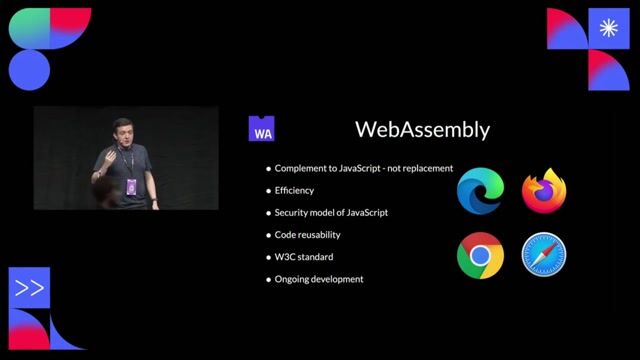
Core principles and security model of WebAssembly
Stefan Schöberl · World Congress 2023
4:54 min
The origins and design principles of WebAssembly
Maurice Brinkmann · World Congress 2023
3:36 min
Core concepts of WebAssembly portability and sandboxed execution
 Gaurav Gahlot · World Congress 2026 Europe
2:40 min
Core concepts and execution mechanics of WebAssembly modules
 Edo · World Congress 2024
5:06 min
Origins and design goals of WebAssembly
Matt Butcher · World Congress 2023
2:27 min
Introduction to WebAssembly in a cloud computing context
Edo · World Congress 2024
More from World Congress 2023
Related videos
Related articles

CH
Chris Heilmann

BB
Benedikt Bischof
.gif)
DC
Daniel Cranney

From learning to earning
Jobs that call for the skills explored in this talk.
about 2 months ago
Staff Hardware Security Engineer

Arm
München, Germany
€131k
U-Boot
Firmware
System on a…
about 1 month ago
Senior Software Engineer, Sandboxes (Eu Or East Coast Preferred)

Docker, Inc.
Madrid, Spain
€94k–155k
Remote
Docker
Adobe InDesign
Virtual Agents
about 1 month ago
Senior Software Engineer, Sandboxes (Eu Or East Coast Preferred)
Docker, Inc.
Barcelona, Spain
€94k–155k
Remote
Linux
Docker
Code Review
8 days ago
SoC Security Architecture
ARM
Austin, TX, United States
$198k–268k
U-Boot
Firmware
Cyber Security
about 1 month ago
Senior Software Engineer, Sandboxes (Eu Or East Coast Preferred)
Docker, Inc.
Granada, Spain
€94k–155k
Remote
Linux
Docker
Code Review
about 1 month ago
Senior Software Engineer, Sandboxes (Eu Or East Coast Preferred)
Docker, Inc.
Santiago de Compostela, Spain
€94k–155k
Remote
Linux
Docker
Code Review