




WeAreDevelopers LIVE Mar 22, 2024

Wasm Deep Dive - A Glance Behind the Scenes

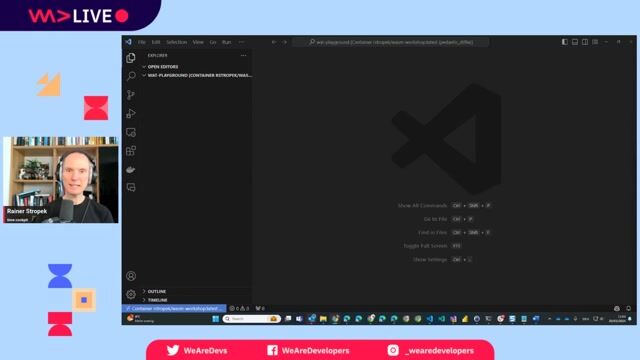
Rainer Stropek

Think WebAssembly is universally faster than JavaScript? Look under the hood of its stack-based virtual machine, linear memory isolation, and host imports to see how it truly operates.

Pause
Mute Enter Fullscreen
#1 about 3 min

Obtaining compiler tools and exploring WebAssembly environments

A provided GitHub repository and Docker instance supply developers with necessary development environments and compiler tools.

#2 about 3 min

Understanding WebAssembly as a portable compilation target

WebAssembly serves as a portable target that translates higher-level code architectures into universally executable binary instructions.

#3 about 3 min

Writing the first basic module using WebAssembly text format

Compiling a foundational text module relies on the WebAssembly binary toolkit to establish generic execution structures.

#4 about 6 min

Defining functions and handling parameters on the stack

An exported WebAssembly text method processes integer variables and pushes evaluated results to a virtual instruction stack.

#5 about 4 min

Instantiating WebAssembly modules from a Node environment

A Node.js driver script loads imported binary files into memory and triggers exported WebAssembly functions asynchronously.

#6 about 6 min

Parsing string inputs using WebAssembly text logic loops

Custom parsing logic safely processes numeric characters within string buffers using fundamental conditional statements and looping labels.

#7 about 5 min

Reading bytes from linear memory to process stack operators

WebAssembly characters read from memory directly evaluate dynamic index buffers via fundamental multi-value stack pop operations.

#8 about 4 min

Decompiling binary modules into readable WebAssembly text

Decompiling binary instruction files into textual layouts clarifies how arbitrary stack operations translate into nested logic expressions.

#9 about 5 min

Securing environments through isolated linear memory allocation

A dedicated block of continuous memory bits proactively secures physical hosts by restricting low-level operational pathways.

#10 about 4 min

Bridging WebAssembly constraints via functional host imports

External callback events securely extend WebAssembly capabilities to restricted local interfaces and isolated network drive endpoints.

#11 about 4 min

Executing WebAssembly functions natively across distinct programming languages

Host wrappers configured in Rust, TypeScript, and C establish independent environments to efficiently handle linear memory transfers.

#12 about 7 min

Utilizing the WebAssembly system interface for native outputs

The standardized WASI execution interface grants restricted WebAssembly files limited accessibility to native operating system outputs.

#13 about 4 min

Evaluating performance differences between WebAssembly and JavaScript

Developers must benchmark computational boundaries to identify if low-level compilation performs strictly faster than local JavaScript environments.

#14 about 4 min

Managing structured object exchanges with interface type models

Interface typing extensions actively bypass linear memory restrictions to support structured object parsing across heterogeneous language infrastructures.

#15 about 2 min

Selecting debugging strategies for distinct compilation toolchains

Built-in browser features and dedicated IDE capabilities precisely troubleshoot variable configurations across abstracted code executions layers.

Matching moments

1:48 min

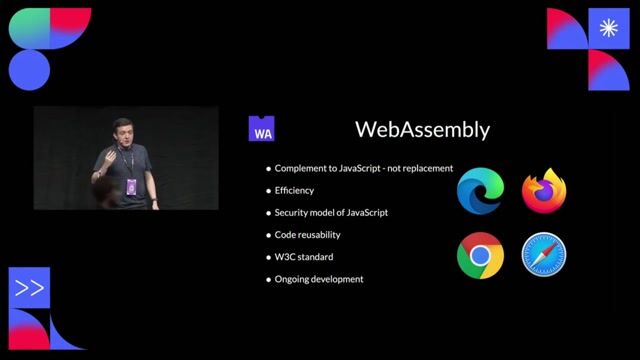
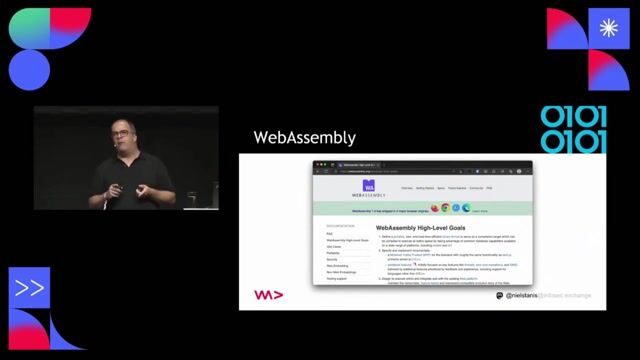
Introduction to WebAssembly as a compilation target

Niels Tanis Niels Tanis · WWC 2023

4:54 min

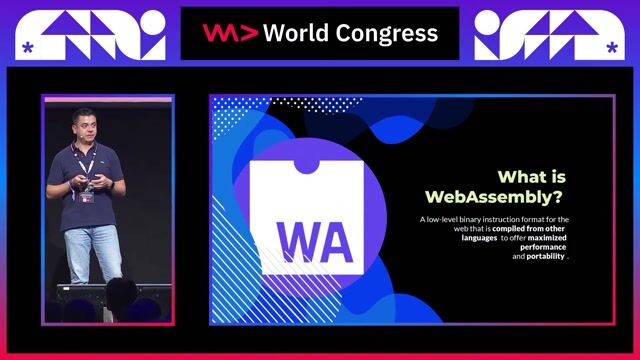
The origins and design principles of WebAssembly

Maurice Brinkmann · WWC 2023

1:32 min

Core principles and security model of WebAssembly

Stefan Schöberl · WWC 2023

2:51 min

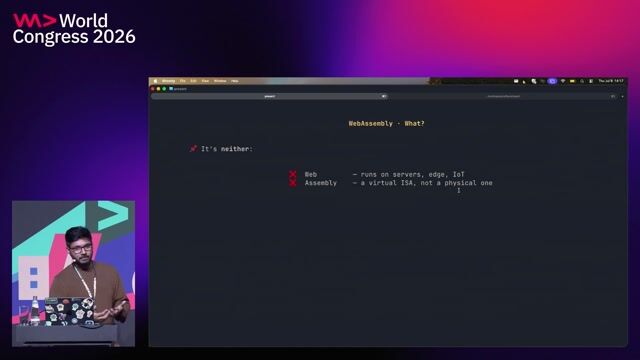
Understanding the WebAssembly binary format and its execution sandbox

Önder Ceylan Önder Ceylan · WWC 2024

2:40 min

Core concepts and execution mechanics of WebAssembly modules

Edo Edo · WWC 2024

2:27 min

Introduction to WebAssembly in a cloud computing context

Edo Edo · WWC 2024

Upcoming sessions on this topic

Open session

World Congress 2026 North America

Fast by Design: A Masterclass in High-Performance Web Engineering

Aaron Grogg

Senior web developer, committed to improving the user experience by improving web performance

Aaron Grogg
Open session

World Congress 2026 North America

When Humans Stop Writing Code: Rethinking Languages, Compilers, and Responsibility

Simon Auer

Organizer of flutter vienna meetup and CEO of marqably

Simon Auer
Open session

World Congress 2026 North America

Small LLM in your Browser: Huge Opportunities for Web Applications

Daniel Ostrovsky

UI/UX Architect at Payoneer | AI Architect | Full Cycle Development Expert | Public Speaker | Open Source Contributor |

Daniel Ostrovsky
Open session

World Congress 2026 North America

Offloading IoT State: Solving the Memory Crisis on Legacy Hardware

Pravin Nagare

Senior Software Engineer, Roku

Pravin Nagare
Open session

World Congress 2026 North America

Honey, look! I vibe-coded an OS!

Ian Smith

CTO, LYOS

Ian Smith
Open session

World Congress 2026 North America

Stop Running Mystery Meat in Production

Jeroen van Erp

Technical Advocate @ SUSE

Jeroen van Erp