




World Congress 2021 Jun 29, 2021

6 tip to reduce your AWS bill

Sébastien Stormacq

Are idle instances secretly inflating your cloud costs? Discover six actionable engineering strategies to eliminate AWS money leaks and cut your compute bills by up to 90%.

Pause
Mute Enter Fullscreen
#1 about 6 min

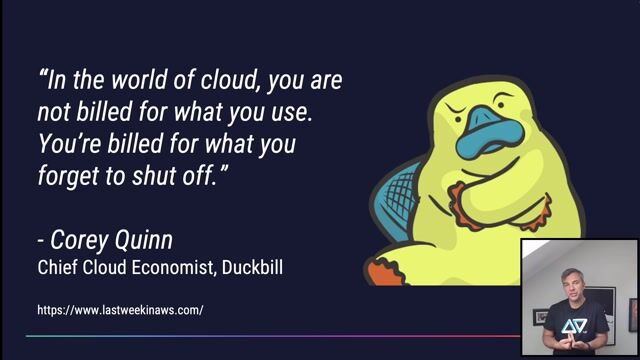
Understanding the nature of on-demand cloud billing

The shift from fixed hardware costs to usage-based billing requires proactive usage management.

#2 about 4 min

Automating storage savings with S3 intelligent tiering

Lifecycle rules and access patterns dictate when data moves to cheaper storage classes to lower monthly costs.

#3 about 4 min

Scheduling automatic shutdowns for development and testing environments

Automatically stopping non-production database functionality and servers outside of working hours mitigates unused compute expenses.

#4 about 6 min

Leveraging EC2 spot instances for stateless workloads

Unused compute capacity offers substantial discounts for containerized and transient tasks capable of handling interruptions.

#5 about 7 min

Applying compute savings plans for baseline capacity pricing

Committing to a predictable compute expenditure threshold yields significant hourly discounts across a flexible range of resource types.

#6 about 4 min

Utilizing reserved instances for specialized database workloads

Purchasing upfront capacity terms offsets standard operating margins for sustained relational and clustered database configurations.

#7 about 8 min

Identifying and deleting orphaned AWS foundational resources

Locating detached storage volumes and static IP addresses via advisor tooling terminates completely unproductive residual infrastructure expenses.

#8 about 3 min

Configuring core billing dashboards and customized financial alerts

Setting predefined spending thresholds provides protective warnings against unintended experimentation costs running passively.

#9 about 5 min

Clarifying storage retrieval costs and automated shutdown risks

Automatic termination configurations introduce operational dangers that warrant careful consideration over basic notification solutions.

Matching moments

1:41 min

Reducing cloud infrastructure waste through custom tools

Daisy Muyldermans · LIVE

2:10 min

Applying the Frugal Architect mental model

Joachim Aumann Joachim Aumann +1 · WWC 2025

43 sec

Identifying and removing unused resources in Azure

Michaël Hompus Michaël Hompus · WWC 2025

1:48 min

Optimizing cloud spend and resources through automated finops

Raz Cohen · LIVE

2:50 min

Optimizing centralized cloud infrastructures for direct energy footprint reductions

Michael Mueller Michael Mueller · WWC 2024

42 sec

Eliminating unused data and reducing cloud resource waste

Kent Simonsen · WWC 2023

Upcoming sessions on this topic

Open session

World Congress 2026 North America

public void saveMoney(AI): The Developer's Guide to Unit Economics

Hrushikesh Pokala

Senior Software Engineer Lead at Equifax

Hrushikesh Pokala
Open session

World Congress 2026 North America

Optimizing consumption and cost of AI APIs in the enterprise

Derric Gilling

Vice President and General Manager, API Platform

Derric Gilling
Open session

World Congress 2026 North America

The $0.15/month Algo-Trader: Architecting High-Performance Serverless Trading Engines

Vishwak Thatikonda

Lead Full Stack Engineer at SDH Systems

Vishwak Thatikonda
Open session

World Congress 2026 North America

When Logging Becomes The Outage: Escaping the ECS Logging Trap

Rahul Tanniru

Senior Vice President Of Software Engineering, Jp Morgan Chase

Rahul Tanniru
Open session

World Congress 2026 North America

Boring Failover: Predictable Region Recovery Across 5,000 Microservices

Garvit Kataria, Sahil Sabharwal

Garvit Kataria
Sahil Sabharwal
Open session

World Congress 2026 North America

Autonomous Infrastructure: Building AI Agents for Global-Scale Capacity Efficiency

Gregoire Colin, Tommy Tran

Gregoire Colin
Tommy Tran