What if the secret to better application architecture wasn't design patterns, but simply writing testable code?
#1about 3 minutes
How unit testing helps overcome early programming struggles
Unit testing provides quick feedback and encourages better code structure, making it easier for new programmers to understand and debug their work.
#2about 2 minutes
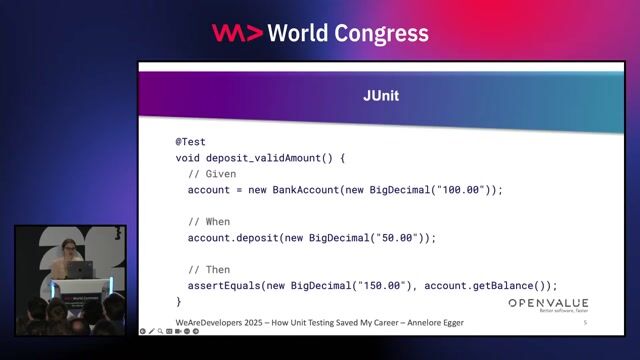
Structuring clear and simple unit tests
Adopting a consistent structure like "Given-When-Then" and using descriptive method names makes tests easier to understand and maintain.
#3about 4 minutes
How writing testable code leads to cleaner code
Refactoring a monolithic method into smaller, testable units naturally improves code readability, maintainability, and overall quality.
#4about 2 minutes
Using test-driven development to guide implementation
Test-driven development (TDD) forces you to think about requirements first, leading to more structured code and serving as a form of documentation.
#5about 3 minutes
Isolating dependencies with mocking frameworks like Mockito
Mocking frameworks like Mockito allow you to isolate the unit under test by replacing external dependencies with controlled mock objects.
#6about 3 minutes
The vicious cycle of untestable legacy code
A lack of tests in legacy code creates a vicious cycle where developers fear refactoring, leading to worse code that is even harder to test.
#7about 3 minutes
Using parameterized tests for efficient test coverage
Parameterized tests in JUnit allow you to run a single test method with multiple input values, simplifying the process of covering various scenarios and edge cases.
#8about 3 minutes
Challenging and simplifying complex test setups
When faced with a complex test setup, challenge its necessity by asking why it exists and explore simplifying it by improving code testability or using mocks.
#9about 2 minutes
Understanding the test pyramid and single responsibility
The test pyramid guides the ratio of unit, integration, and end-to-end tests, with units being small pieces of code that adhere to the single responsibility principle.
#10about 1 minute
Final thoughts on unit testing as a developer's tool
Treat unit tests as a valuable development tool, and if they become a source of friction, investigate and challenge the underlying code or test setup complexity.
Related jobs
Jobs that call for the skills explored in this talk.
What Developers Really Need to Create Great Code DemosEvery developer on earth has, at some point, had another developer to thank for a breakthrough, a success, an aha moment they wouldn’t have had without coming across that blog post, that open-source contribution, that reply on socials or that humble ...
Christina Schaireiter
Why Attend a Developer Event?Modern software engineering moves too fast for documentation alone. Attending a world-class event is about shifting from tactical execution to strategic leadership.
Skill Diversification: Break out of your specific tech stack to see how the industry...