How do you safely deploy complex AI into safety-critical automotive systems? It requires separating cloud development from in-car execution.
#1about 3 minutes
The complexity of AI in safety-critical automotive software
AI introduces a new dimension of complexity to automotive software, requiring both an AI.SDK for development and an AI Runtime for in-car execution.
#2about 5 minutes
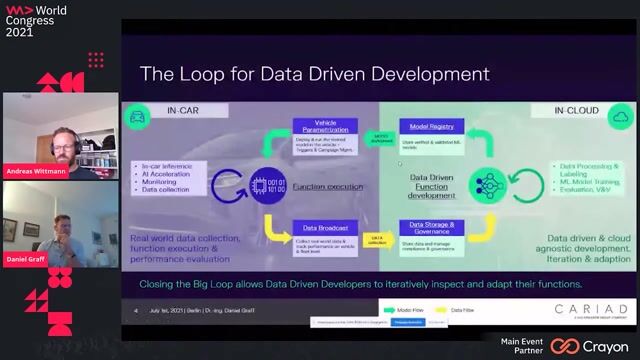
Overview of the data-driven development lifecycle for cars
The end-to-end machine learning loop involves cloud-based data processing, training, and optimization, followed by in-car deployment, inference, and monitoring.
#3about 7 minutes
The role of the AI runtime in the VW.OS
The AI Runtime Environment abstracts hardware and manages optimized model inference within the centralized Volkswagen Operating System (VW.OS).
#4about 1 minute
Comparing platform-dependent and independent model deployment strategies
Models can be deployed as a standard format like ONNX for on-device compilation or as a pre-compiled binary from the cloud for direct execution.
#5about 3 minutes
Why a unified AI.SDK is essential for automotive development
An AI.SDK provides a standardized and abstracted way to develop applications, tackling the challenges of AI safety and a heterogeneous hardware landscape.
#6about 6 minutes
Standardizing data preparation and management in the AI.SDK
The data preparation component of the SDK standardizes pre-processing, ensures data consistency, and enriches metadata to enable traceability and active learning.
#7about 4 minutes
Evaluating model performance and robustness with dedicated libraries
The AI.SDK includes components for performance evaluation and adversarial robustness checks, using a dedicated DNN test metric library for standardization.
#8about 2 minutes
Productionizing models through compression and hardware-aware optimization
The productionization step uses techniques like compression, quantization, and neural architecture search to reduce model size and improve inference time on target hardware.
#9about 6 minutes
Skills and challenges of working with automotive AI
Working in automotive AI requires a mix of software, hardware, and statistics skills to tackle challenges like massive data volumes and embedded system constraints.
#10about 2 minutes
Tooling, hiring, and how to get involved
The team uses standard MLOps tools like TensorFlow, PyTorch, and MLflow on the Azure cloud and is actively hiring for open positions.
Related jobs
Jobs that call for the skills explored in this talk.
With AIs wide open - WeAreDevelopers at All Things Open 2025Last week our VP of Developer Relations, Chris Heilmann, flew to Raleigh, North Carolina to present at All Things Open . An excellent event he had spoken at a few times in the past and this being the “Lucky 13” edition, he didn’t hesitate to come and...
Daniel Cranney
Panel Discussion: Responsible AI in Practice - Real-World Examples and ChallengesIntroductionIn the ever-evolving landscape of artificial intelligence, the concept of "responsible AI" has emerged as a cornerstone for ethical and practical AI implementation. During the WWC24 Panel discussion, three eminent experts—Mina, Bjorn Brin...
Chris Heilmann
Exploring AI: Opportunities and Risks for DevelopersIn today's rapidly evolving tech landscape, the integration of Artificial Intelligence (AI) in development presents both exciting opportunities and notable risks. This dynamic was the focus of a recent panel discussion featuring industry experts Kent...
Daniel Cranney
How software is steering vehicle technologyThe automotive industry is entering a transformative era, and developers have a unique opportunity to be part of it. Cars are no longer just mechanical machines; they’re sophisticated tech platforms with software at their core. This shift, defined by...
From learning to earning
Jobs that call for the skills explored in this talk.