
World Congress 2026 Europe - Virtual Stage Jul 2, 2026 Session details

Offline-First Engineering for Disaster-Ready Applications

Aaditya Binod Yadav

How do you build applications that survive total network collapse during natural disasters? Learn why true offline-first engineering requires abandoning central servers and adopting hybrid logical clocks.

Pause
Mute Enter Fullscreen
#1 about 4 min

Discovering offline-first as a distributed systems problem

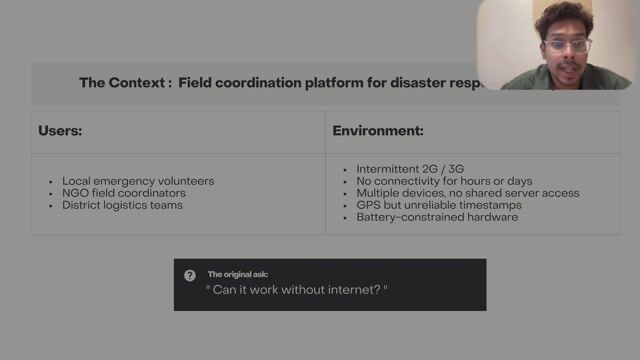
The 2015 Nepal earthquake revealed that reliable software in disaster zones requires rethinking fundamental network assumptions.

#2 about 3 min

Concurrent writes and the breakdown of naive caching approaches

Field coordination involves multiple concurrent users operating offline, rendering simple caching strategies ineffective.

#3 about 4 min

Abandoning the server as the single source of truth

Treating clients as authorities during network partitions shifts the architectural focus from central consistency to divergent state merging.

#4 about 5 min

Replacing unreliable physical clocks with hybrid logical clocks

Device clock drift necessitates using logical time structures like vector and hybrid logical clocks to accurately track causal ordering.

#5 about 8 min

Shifting from syncing state to replicating immutable operation logs

Modeling node architectures around append-only operation logs and materialized views enables robust offline synchronization.

#6 about 5 min

Designing domain-specific semantic merge rules for state conflicts

Relying on last-write-wins leads to silent data loss, making state machine-based semantic merging a safer approach.

#7 about 3 min

Applying conflict-free replicated data types for reliable convergence

Mathematical structures like grow-only counters and two-phase sets provide conflict-free merging for specific offline data types.

#8 about 7 min

Prioritizing availability and exposing staleness in the user interface

Selecting network partition tolerance mandates making data staleness and synchronization uncertainty transparent to users.

#9 about 3 min

Evaluating unexpected chaotic behaviors in offline field environments

Real-world testing reveals that phenomena like local storage exhaustion and social synchronization dictate actual system resilience.

#10 about 6 min

Weighing the heavy architectural complexity budget against offline capabilities

The massive engineering costs of peer-to-peer data synchronization are only justified when network partitions are unavoidable.

#11 about 4 min

Adopting practical engineering standard changes for resilient system architectures

Auditing connectivity assumptions, defining conflict semantics, and measuring replication lag serve as foundational steps for building reliable software.

Matching moments

6:09 min

Understanding offline first applications and the CAP theorem

Sebastien Stormacq Sebastien Stormacq · LIVE

6:50 min

Achieving application reliability and offline accessibility

Ire Aderinokun · JS Congress

2:08 min

Architecting web applications for seamless offline availability

Nico Martin · LIVE

3:09 min

Hardware evolution and offline-first network infrastructure

Phil Helliwell · WWC 2023

3:04 min

Addressing network challenges and offline edge synchronization

Sasha Denisov Sasha Denisov +1 · WWC Europe 2026

2:07 min

Distinguishing offline-first capabilities from true local-first values

Alexander Opalic Alexander Opalic · WWC Europe 2026

Upcoming sessions on this topic

Open session

World Congress 2026 North America

Boring Failover: Predictable Region Recovery Across 5,000 Microservices

Garvit Kataria, Sahil Sabharwal

Garvit Kataria
Sahil Sabharwal
Open session

World Congress 2026 North America

Fault Tolerance and Consistency at Scale: Harnessing the Power of Distributed SQL Databases

Wei Hu

Senior Vice President of Research and Development

Wei Hu
Open session

World Congress 2026 North America

Offloading IoT State: Solving the Memory Crisis on Legacy Hardware

Pravin Nagare

Senior Software Engineer, Roku

Pravin Nagare
Open session

World Congress 2026 North America

How to generate business value through performance optimizations

Nikolai Sidiropulo

Software Engineer at Meta

Nikolai Sidiropulo
Open session

World Congress 2026 North America

You Can’t Re-Run Sunlight: Designing ML Data Architectures for Physical AI

An Phan

Senior Data Infrastructure Engineer @ Hippo Harvest

An Phan
Open session

World Congress 2026 North America

The Geometry of Incidents: What User-Impact Shapes Reveal About Platform Architecture

Bala Subrahmanyam Kambala

Staff Platform Engineer at Oracle Cloud Infrastructure

Bala Subrahmanyam Kambala