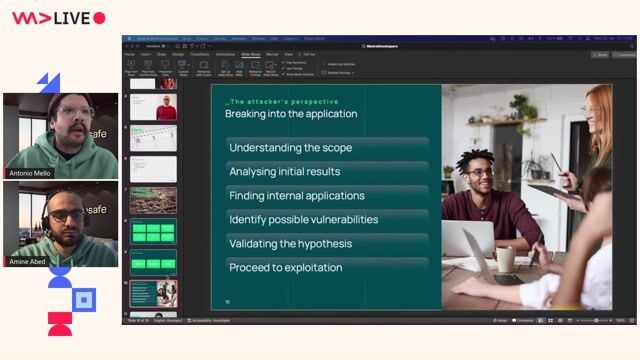
Chaining low-severity bugs can lead to a full system compromise. We'll show you how to trace the attacker's every step.
#1about 10 minutes
Defining key cybersecurity tools and terminology
An overview of essential information security concepts and tools is provided, including nmap, Burp Suite, IDOR, LFI, and SIEM platforms.
#2about 16 minutes
Performing reconnaissance with an nmap port scan
The initial attack phase begins with an nmap scan to discover open ports and services, identifying potential web applications and an Apache server.
#3about 11 minutes
Gaining initial access with default credentials
After failed SQL injection attempts, access is gained by logging in with common default credentials and a path disclosure vulnerability is found via a malformed JSON.
#4about 13 minutes
Exploiting broken access control with cookie tampering
A base64-encoded cookie is manipulated to access another organization's data, and fuzzing reveals a hidden admin parameter to view sensitive information.
#5about 10 minutes
Reading sensitive files with a path traversal exploit
A known path traversal vulnerability in the Apache server is exploited to read the `/etc/passwd` file and a sensitive configuration file containing credentials.
#6about 1 minute
Achieving remote access via SSH with guessed credentials
Using the leaked username, the password from the configuration file is modified by incrementing the year to successfully log into the server via SSH.
#7about 21 minutes
Analyzing API logs to trace the attacker's steps
The defender analyzes API logs to identify failed SQL injection attempts, a successful login, parameter fuzzing, and cookie manipulation by observing response codes and body sizes.
#8about 15 minutes
Correlating web server and authentication logs
Apache and authentication logs are examined to find evidence of the nmap scan, the path traversal exploit, and the final successful SSH login after several failed attempts.
#9about 13 minutes
Demonstrating a SIEM for automated threat detection
A Security Information and Event Management (SIEM) tool is shown to automatically detect and flag suspicious activity, such as the nmap user agent, in real-time.
#10about 18 minutes
Summarizing vulnerabilities and key security recommendations
The workshop concludes with a summary of the attack chain and provides key recommendations for developers and defenders, such as patch management and maintaining high-quality logs.
Related jobs
Jobs that call for the skills explored in this talk.
Dev Digest 138 - Are you secure about this?Hello there! This is the 2nd "out of the can" edition of 3 as I am on vacation in Greece eating lovely things on the beach. So, fewer news, but lots of great resources. Many around the topic of security. Enjoy! News and ArticlesGoogle Pixel phones t...
Why Developers are So Excited About PretextPretext is a new JavaScript and TypeScript library from Cheng Lou - previously a React core developer - that crossed 7,000 GitHub stars in three days to get the entire tech world talking recently.
The demos that spread were visually striking: dragon...
Daniel Cranney
Dev Digest 198: 30 years of JS, In-Browser AI, How Attackers Abuse GenAI Inside last week’s Dev Digest 198 .
🎂 30 years of JavaScript
⏰ How long is a JavaScript second
💻 Clean code in Angular
🤦♂️ AI makes different mistakes than humans
👨💻 In-browser and offline AI
🟠 Undocumented Hacker News features
🐋 DeepSeek censored...
From learning to earning
Jobs that call for the skills explored in this talk.