



World Congress 2024 Aug 20, 2024 Session details

Semi-Supervised Learning. How to overcome the lack of labels

Alex Timashov

Data labeling is an expensive bottleneck. What if you could hit 95% accuracy with just 100 labels? Discover how semi-supervised learning makes this a reality.

Pause
Mute Enter Fullscreen
#1 about 6 min

Financial and temporal costs of data labeling

High financial costs and extensive time requirements drive the need for alternatives to fully supervised machine learning.

#2 about 5 min

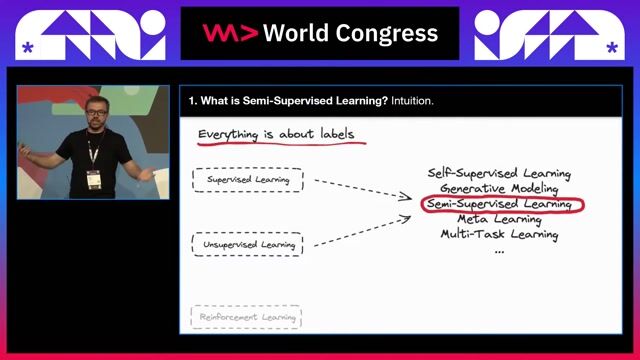
Core intuition connecting supervised and unsupervised learning

Combining small labeled sets with abundant unlabeled examples bridges the gap between purely supervised and unsupervised methods.

#3 about 3 min

Applying entropy minimization and pseudo labeling

Minimizing classification entropy on unlabeled data helps establish confident decision boundaries in semi-supervised training.

#4 about 4 min

Maintaining class consistency with stochastic image augmentations

Applying random transformations like rotation and cropping to unlabeled images preserves original class identities for consistent training.

#5 about 5 min

Techniques for text augmentation and virtual adversarial attacks

Advanced augmentation strategies like back-translation and virtual adversarial training generate reliable variations for complex text and image datasets.

#6 about 3 min

Leveraging generative models to learn semantic data structures

Generative modeling extracts underlying structural patterns from unlabeled data to substantially improve basic classification boundaries.

#7 about 4 min

Applying variational autoencoders to semi-supervised classification

Integrating variational autoencoders with standard classification models significantly boosts model accuracy despite extremely small labeled sample sizes.

#8 about 1 min

Summarizing the mechanics of semi-supervised frameworks

Effectively merging supervised constraints with expansive unlabelled distributions is the foundation of modern semi-supervised loss functions.

Matching moments

2:03 min

Structuring the machine learning solution approach architecture

Lukas Kölbl · LIVE

2:33 min

Generating synthetic training data to resolve labeling challenges

Teresa Conceicao · WWC 2022

3:00 min

Cleaning missing values and expanding datasets with data augmentation

Lutske van der Meer Lutske van der Meer · WWC 2024

4:38 min

Preparing data and labeling for supervised learning

Antonia Hahn · WWC 2023

1:45 min

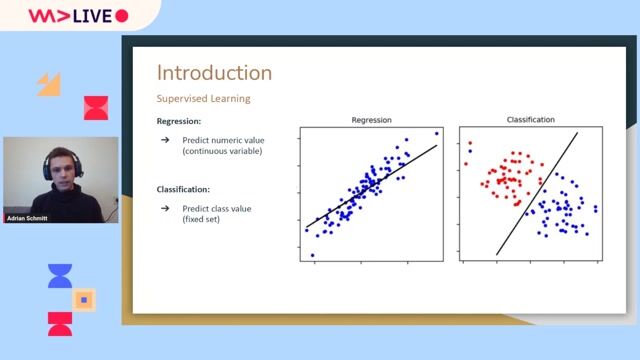
Supervised, unsupervised, and reinforcement learning paradigms explained

Alexandra Waldherr · LIVE

1:22 min

Increasing model accuracy through synthetic data generation

Ekaterina Sirazitdinova · WWC 2023

Upcoming sessions on this topic

Open session

World Congress 2026 North America

You Can’t Re-Run Sunlight: Designing ML Data Architectures for Physical AI

An Phan

Senior Data Infrastructure Engineer @ Hippo Harvest

An Phan
Open session

World Congress 2026 North America

Building Stuff with GenAI - The Open Minded Workshop beyond OpenAI

Andreas Erben

CTO for Applied AI and Metaverse at daenet

Andreas Erben
Open session

World Congress 2026 North America

Fast, Cheap, and Accurate: Optimizing LLM Inference with vLLM and Quantization

Cedric Clyburn, Legare Kerrison

Cedric Clyburn
Legare Kerrison
Open session

World Congress 2026 North America

No Single Model to Rule Them All: Building Resilient AI Agents Across Open & Closed LLMs

Emmanuel Acheampong

Senior Manager Developer Relations at Crusoe AI

Emmanuel Acheampong
Open session

World Congress 2026 North America

Understanding LLM Architectures: Inside the Design of Modern Models

Jofia Jose Prakash

Enterprise AI Architect at American Chemical Society

Jofia Jose Prakash
Open session

World Congress 2026 North America

Context Engineering Kung Fu

Carl Lapierre

Tech Lead and AI Engineer at Osedea

Carl Lapierre