Develop a Blockchain Application in JavaScript with Lisk SDK
What if you could build a supply chain traceability system on a blockchain, entirely in JavaScript? This workshop shows you how.
#1about 4 minutes
Introducing the Lisk Grant Program and Core 3.0 release
Learn about the Lisk Grant Program for funding new projects and the upcoming features in the Lisk Core 3.0 release.
#2about 5 minutes
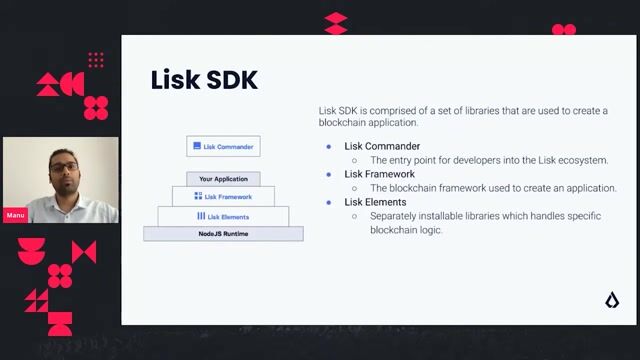
Understanding the Lisk SDK architecture
Explore the core architectural concepts of the Lisk SDK, including on-chain modules, off-chain plugins, and their communication channels.
#3about 4 minutes
Bootstrapping an application with the Lisk SDK
Discover how the Lisk SDK bootstrapping feature quickly creates a new application with helpful tools like a dashboard, faucet, and testing framework.
#4about 3 minutes
Setting up the development environment
Follow the steps to install the required prerequisites for the workshop, including a specific Node.js version and the Lisk Commander CLI tool.
#5about 6 minutes
Initializing a new blockchain application
Use the `lisk init` command to generate a new blockchain application and review the default project structure, including the genesis block.
#6about 9 minutes
Defining the supply chain traceability use case
Understand the problem of foodborne disease outbreaks and how a blockchain application can provide traceability for producers, suppliers, and consumers.
#7about 11 minutes
Generating modules and assets for on-chain logic
Use the `lisk generate` command to create custom modules for producers and suppliers, along with assets to handle product creation and transfer.
#8about 18 minutes
Implementing the product creation asset logic
Define the data schema for a product and implement the validation and apply logic to handle the state mutation for creating new products.
#9about 17 minutes
Implementing product transfer between modules with reducers
Learn how to use reducers to enable communication between the supplier and producer modules to transfer ownership of products on-chain.
#10about 9 minutes
Configuring the genesis block and running the application
Update the application's genesis block to include the new custom modules and their initial state before starting the blockchain node.
#11about 14 minutes
Interacting with the app using dashboard and API plugins
Use the built-in dashboard plugin to send transactions for creating products and the HTTP API plugin to query the blockchain's state.
#12about 11 minutes
Key benefits of building with the Lisk SDK
Review the advantages of using the Lisk SDK, such as high transaction throughput, a dynamic fee system, and overall developer accessibility.
Related jobs
Jobs that call for the skills explored in this talk.
Why Blockchain? A Developer’s PerspectiveFor many developers, blockchain feels like that one friend who keeps trying to sell you on their side hustle: persistent, occasionally confusing, and often surrounded by hype. But behind the buzzwords and market noise lies a technology with real engi...
Algorand Foundation
From Hype to Code: Real Blockchain Use Cases for DevelopersSo you’ve wrapped your head around why blockchain exists . You’re on board with the concepts: decentralization, immutability, and trust-minimized infrastructure. But now comes the real question:
What can you actually build with it?
This post is for d...
Why Attend a Developer Event?Modern software engineering moves too fast for documentation alone. Attending a world-class event is about shifting from tactical execution to strategic leadership.
Skill Diversification: Break out of your specific tech stack to see how the industry...
From learning to earning
Jobs that call for the skills explored in this talk.