A Primer in Single Page Application Security (Angular, React, Vue.js)
Think your SPA is safe from XSS? Learn how modern frameworks can still leave you vulnerable and how to properly secure your application.
#1about 3 minutes
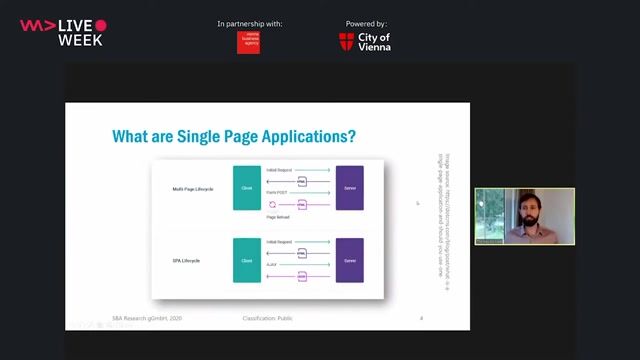
Understanding single page application architecture
Single page applications improve speed and separation of concerns by rendering HTML on the client-side and fetching data via APIs.
#2about 5 minutes
The primary security threat of cross-site scripting
Cross-site scripting (XSS) is the main vulnerability in SPAs, where untrusted data is mixed with markup, leading to malicious code execution in the user's browser.
#3about 3 minutes
How Angular, React, and Vue handle innerHTML security
Angular automatically sanitizes `innerHTML` to prevent XSS, while React's `dangerouslySetInnerHTML` and Vue's `v-html` require manual care.
#4about 4 minutes
Securing dynamic attributes like href and src
Dynamic `href` attributes can execute JavaScript via `javascript:` URLs, and dynamic `src` or `style` attributes also pose XSS risks.
#5about 3 minutes
Using DOMPurify for robust HTML sanitization
Use the DOMPurify library to safely render untrusted HTML in frameworks like React and Vue, or to customize Angular's strict default sanitizer.
#6about 3 minutes
Why you should avoid direct DOM manipulation
Bypassing framework template engines by using direct DOM functions like `document.write` or `eval` reintroduces significant XSS vulnerabilities.
#7about 3 minutes
Using Content Security Policy for defense in depth
Implement a Content Security Policy (CSP) via HTTP headers to restrict script sources and disable inline scripts, providing a strong second layer of defense against XSS.
#8about 2 minutes
The future of XSS prevention with Trusted Types
The upcoming Trusted Types CSP directive will prevent strings from being passed to dangerous DOM functions, effectively creating a strongly-typed and safer DOM API.
#9about 3 minutes
A practical checklist for preventing XSS in SPAs
Follow a security checklist that includes using framework templates, sanitizing HTML with DOMPurify, and implementing a Content Security Policy.
#10about 3 minutes
Managing security risks in third-party dependencies
Regularly scan your project's dependencies for known vulnerabilities using tools like `npm audit` and automate the update process to mitigate risks from external code.
#11about 4 minutes
Essential web security best practices beyond SPAs
Ensure overall application security by enforcing TLS, using SameSite cookies, correctly configuring CORS, and securing WebSocket connections.
Related jobs
Jobs that call for the skills explored in this talk.
The HTML Elements That You’re Probably Over-EngineeringAs frameworks have become more and more commonplace in the world of web development, so too has the over-engineering of features made possible by our humble old friend, HTML.
The mental models that come with using state management in React, Vue and o...
Daniel Cranney
Why Developers are So Excited About PretextPretext is a new JavaScript and TypeScript library from Cheng Lou - previously a React core developer - that crossed 7,000 GitHub stars in three days to get the entire tech world talking recently.
The demos that spread were visually striking: dragon...
Christina Schaireiter
Security Basics for Vibe CodersVibe coding has become a popular trend in the tech world. With so many tools now available for both developers and non-developers, it’s easier than ever to build projects using natural language, in some cases without touching a line of code along the...
Daniel Cranney, Chris Heilmann
Dev Digest 215: Agent Memory, JS2026, Googlebot Analysis & Canvas❤️HTMLInside last week’s Dev Digest 215 .
🗿 Make AI talk like a caveman
🧠 A guide to context engineering for LLMs
🤖 Simon Willison on agentic engineering
🔐 Axios supply chain attack post mortem
🛡️ Designing AI agents to resist prompt injection
🎨 HTML in c...
From learning to earning
Jobs that call for the skills explored in this talk.