World Congress 2026 Europe Jul 9, 2026 Session details

An alternative approach to digital sovereignty: Confidential Computing

Mike Bursell

Who can access your data while it processes in RAM? Discover how confidential computing leverages hardware-based isolation to physically block hypervisor-level extraction and secure your digital sovereignty.

Pause
Mute Enter Fullscreen
#1 about 2 min

Understanding national, organizational, and personal digital sovereignty

Defining digital sovereignty across national, corporate, and individual levels highlights the complexities of modern data protection.

#2 about 2 min

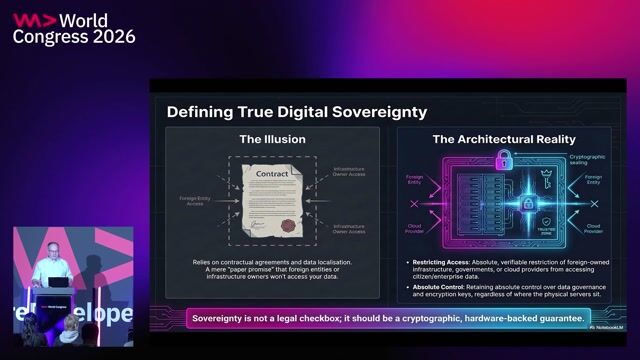
Moving from legal contracts to technical hardware guarantees

Replacing paper agreements with hardware-backed cryptography prevents external entities from accessing highly controlled environments.

#3 about 1 min

Proving regulatory compliance to auditors and chief officers

Demonstrating technical protections against fast-moving cyber threats meets the strict requirements of regulatory bodies.

#4 about 2 min

Protecting data in use to prevent administrative exposure

Encrypting data directly in system RAM mitigates risks posed by privileged users traversing virtualized cloud environments.

#5 about 2 min

Creating trusted execution environments using specialized computing hardware

Utilizing widely available CPUs and GPUs to build trusted execution environments isolates memory pages from hypervisor oversight.

#6 about 2 min

Isolating agentic artificial intelligence workloads from unauthorized access

Securing sensitive model data and prompts guards against internal administrators and unexpected external breaches.

#7 about 4 min

Providing confidentiality, integrity, and remote attestation validation

Cryptographic signatures verify software integrity before execution to ensure remote environments contain exactly the correct application.

#8 about 2 min

Transitioning trust from software policies to central processors

Moving the root of trust away from cloud providers and host operating systems establishes stronger isolation controls.

#9 about 2 min

Utilizing third-party services for unbiased attestation verification

Employing independent attestation checks eliminates the conflict of interest of relying on internal cloud service reports.

#10 about 2 min

Meeting national sovereignty requirements using remote execution environments

Using isolated instances in foreign jurisdictions enables the safe processing of region-locked sovereign data.

#11 about 2 min

Facilitating safe data collaboration via confidential clean rooms

Clean environments permit cross-institutional data analysis without exposing unencrypted raw datasets to competing parties.

#12 about 2 min

Securing digital supply chains using isolated build environments

Generating provenance proofs natively inside secure hardware guarantees the integrity of continuous software bills of materials.

#13 about 2 min

Enabling decentralized computing operations with hardware-level trust

Cryptographically assured deployments empower organizations to distribute computing workloads without exposing private administration keys.

#14 about 2 min

Fostering open-source collaboration for secure computational frameworks

Promoting open-source integration standardizes the implementation of secure computational frameworks across multiple diverse industries.

#15 about 6 min

Addressing availability, latency overheads, and hardware trust concerns

Exploring infrastructure uptime risks, single-digit processing trade-offs, and strategies to secure native encryption keys.

Matching moments

49 sec

Hardware-based trusted execution environments for confidential computing

Rob Nertney Rob Nertney · World Congress 2026 Europe

2:44 min

Advancing confidential computing with open source multi-way collaboration

Mingshen Sun Mingshen Sun · World Congress 2024

4:08 min

Securing data in use with confidential cloud computing

Isha Salania Isha Salania · World Congress 2026 Europe

2:48 min

Utilizing trusted execution environments for data protection

Mingshen Sun Mingshen Sun · World Congress 2026 Europe

2:59 min

Defining trusted execution environments and confidential computing

Liz Moy · LIVE

1:37 min

Defining digital sovereignty and a four-part solution framework

Isha Salania Isha Salania · World Congress 2026 Europe

Upcoming sessions on this topic

Open session

World Congress 2026 North America

September 24, 2026 · 11:40–12:10

Stage 7

Clean Rooms Demystified: Architecture and Patterns for Privacy-Safe Data Collaboration

Anurag Malik

Data Tech Lead @ Intuit

Anurag Malik
Open session

World Congress 2026 North America

September 25, 2026 · 12:30–14:30

Stage 11

Docker sandboxes: protect your secrets, tokens, and personal data from AI agent mistakes

Kristiyan Velkov

Front-End Advocate | Speaker | AI & DevOps | Docker Captain | Cursor Ambassador | DevReal | Tech Blogger | Book Author

Kristiyan Velkov
Open session

World Congress 2026 North America

September 25, 2026 · 15:30–16:00

Stage 7

Trust, But Verify: Continuous GPU Validation at Scale

Kyle Bell

VP of AI at TensorWave

Kyle Bell
Open session

World Congress 2026 North America

September 24, 2026 · 09:45–10:15

Mainstage

Manufacturing trust: speed and safety in the age of agents

Mark Cavage

Mark Cavage President and COO of Docker

Mark Cavage
Open session

World Congress 2026 North America

September 24, 2026 · 11:00–11:30

Stage 7

Responsible AI Architecture with Zero Trust Agents

Ashok Prakash

Staff ML Engineer at Apple

Ashok Prakash
Open session

World Congress 2026 North America

September 24, 2026 · 17:30–18:00

Stage 5

Securing AI Agent Infrastructure: Identity, Attestation, and Trust at Scale

Abdel Fane

Founder of OpenA2A

Abdel Fane