WeAreDevelopers LIVE Mar 23, 2021

Application Modernization and Rabbits

Niklas Heidloff

Managing a legacy monolith is like keeping a growing rabbit population in a crowded cage. Discover how to iteratively untangle systems into event-driven microservices without boiling the ocean.

Pause
Mute Enter Fullscreen
#1 about 3 min

Application modernization explained through rabbit habitats

Expanding rabbit cages into connected hutches illustrates the agility and efficiency of migrating from monoliths to microservices architectures.

#2 about 3 min

Five core strategies for handling legacy applications

Retiring, migrating, or refactoring older monolithic applications balances cost with the need for competitive software delivery.

#3 about 2 min

Comparing a legacy e-commerce application with modernized architecture

Side-by-side demonstrations of a monolithic Dojo toolkit application and a fully containerized microservices structure clarify the transition path.

#4 about 3 min

Taking incremental steps in an application modernization journey

Breaking a massive architectural overhaul into smaller verifiable phases limits operational risk and proves immediate value.

#5 about 4 min

Migrating monolithic workloads from virtual machines to containers

Tools like cloud transformation advisor automate the generation of container configurations and identify necessary code updates for modern runtimes.

#6 about 3 min

Decoupling interfaces and upgrading to open source application runtimes

Separating interface logic using the backend for frontend pattern and adopting community-supported software reduces licensing costs and simplifies scaling.

#7 about 3 min

Adopting the strangler pattern for initial microservices extraction

Incrementally peeling off high-traffic user flows from legacy systems preserves core application stability while scaling specific functions.

#8 about 4 min

Using runtime analysis tools to identify optimal microservice boundaries

Analyzing method invocation chains helps isolate standalone technical domains and prevents the creation of brittle distributed monoliths.

#9 about 3 min

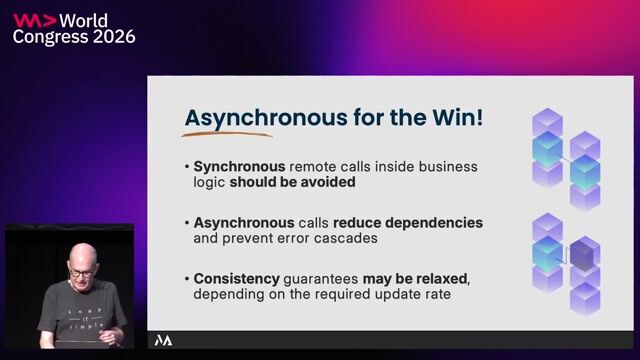
Implementing event-driven architectures to decouple remote service components

Replacing synchronous rest calls with asynchronous messaging and database caching ensures separate architectural domains can function independently.

#10 about 4 min

Selecting efficient java virtual machines and reactive application frameworks

Adopting memory-optimized engines and reactive endpoints drastically reduces container resource consumption and improves high-volume request handling.

#11 about 5 min

Decomposing monolithic user interfaces into responsive micro front ends

Federated interface architectures allow individual technical teams to deploy specific graphical components without blocking broader application releases.

#12 about 2 min

Cloning and deploying the modernized application architecture locally

Accessing sample scripts and open source repositories jumpstarts practical exploration of containerized deployment models.

Matching moments

5:06 min

Modernizing legacy applications through proactive leadership

Babette Wagner Babette Wagner · Coffee With Developers

5:02 min

Transforming legacy monoliths into modern software systems

Henning Schwentner · LIVE

1:43 min

Incremental frontend modernization avoiding full rewrites

Alexander Günsche Alexander Günsche · LIVE

44 sec

Modernizing a legacy Java ERP monolithic architecture

Simon Martinelli Simon Martinelli · WWC Europe 2026

1:32 min

Overcoming modernization challenges in aging monolithic codebases

Igor Minar Igor Minar +1 · WWC 2025

1:59 min

Transforming to a cloud-native modular application architecture

Annette Schelten Annette Schelten +1 · WWC 2025

Upcoming sessions on this topic

Open session

World Congress 2026 North America

From Legacy to Longevity – How a 17-Year-Old System stayed Modern

Alexander Arians

Empowering Engineers to drive innovation

Alexander Arians
Open session

World Congress 2026 North America

API = Some REST and HTTP, right? RIGHT?!

Rustam Mehmandarov

Passionate computer scientist

Rustam Mehmandarov
Open session

World Congress 2026 North America

One Repo, One Strategy: Scalable Full-Stack Testing in a Monorepo World

Bartosz Leczycki, Paweł Matynia

Bartosz Leczycki
Paweł Matynia
Open session

World Congress 2026 North America

MicroAgents: The Microservices of the Agentic Era

Ashish Shubham

Runs the show bussiness at ThoughtSpot

Ashish Shubham
Open session

World Congress 2026 North America

From Cloud Native to Multi-Cloud Native: Write Once, Deploy Anywhere

Sandeep Pal

Principal Member of Technical Staff at Salesforce

Sandeep Pal
Open session

World Congress 2026 North America

Offloading IoT State: Solving the Memory Crisis on Legacy Hardware

Pravin Nagare

Senior Software Engineer, Roku

Pravin Nagare