Hallucinations are the biggest blocker to enterprise LLM adoption. Learn how Retrieval-Augmented Generation provides the factual grounding your models need.
#1about 3 minutes
Understanding LLMs and the transformer self-attention mechanism
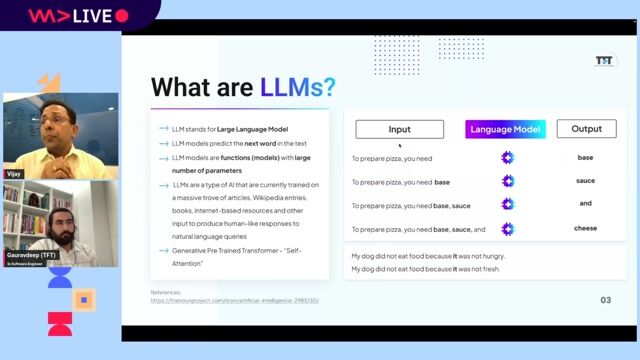
Large Language Models (LLMs) are defined by their parameters and training data, with the transformer's self-attention mechanism being key to resolving ambiguity in language.
#2about 4 minutes
Exploring the business adoption and emergent abilities of LLMs
Businesses are rapidly adopting LLMs due to their emergent abilities like in-context learning, instruction following, and chain-of-thought reasoning, which go beyond their original design.
#3about 9 minutes
Demo of an enterprise assistant for integrated systems
The Simplify Path demo showcases a unified chatbot interface that integrates with various enterprise systems like HRMS, Jira, and Salesforce for both informational queries and transactional tasks.
#4about 3 minutes
Demo of a document compliance checker for pharmaceuticals
The Doc Compliance tool validates pharmaceutical documents against a source-of-truth compliance document to ensure all parameters meet regulatory requirements.
#5about 3 minutes
Demo of a chatbot builder for any website
Web Water is a product that converts any website into an interactive chatbot by scraping its HTML, text, and media content to answer user questions.
#6about 5 minutes
Navigating the common challenges of building with LLMs
Key challenges in developing LLM applications include managing hallucinations, ensuring data privacy for sensitive industries, improving usability, and addressing the lack of repeatability.
#7about 7 minutes
Using prompt optimization to improve LLM usability
Prompt optimization techniques, such as defining a role, using zero-shot, few-shot, and chain-of-thought prompting, can significantly improve the quality and relevance of LLM outputs.
#8about 4 minutes
Advanced techniques like RAG, function calling, and fine-tuning
Overcome LLM limitations by using Retrieval-Augmented Generation (RAG) for domain-specific knowledge, function calling for real-time tasks, and fine-tuning for specialized models.
#9about 10 minutes
Code walkthrough for building a RAG-based chatbot
A practical code demonstration shows how to build a RAG pipeline using LangChain, ChromaDB for vector storage, and an open-source Llama 2 model to answer questions from a specific document.
#10about 9 minutes
Q&A on integration, offline RAG, and the future of LLMs
The discussion covers integrating LLMs into organizations, running RAG offline, suitability for small businesses, and the evolution towards large action models (LAMs).
Related jobs
Jobs that call for the skills explored in this talk.
With AIs wide open - WeAreDevelopers at All Things Open 2025Last week our VP of Developer Relations, Chris Heilmann, flew to Raleigh, North Carolina to present at All Things Open . An excellent event he had spoken at a few times in the past and this being the “Lucky 13” edition, he didn’t hesitate to come and...
Luis Minvielle
What Are Large Language Models?Developers and writers can finally agree on one thing: Large Language Models, the subset of AIs that drive ChatGPT and its competitors, are stunning tech creations. Developers enjoying the likes of GitHub Copilot know the feeling: this new kind of te...
Dev Digest 210: AI Agents Are Go! Is MCP Dead? LLMs Crack AnonymityInside last week’s Dev Digest 210 .
🪦 Is MCP already dead?
🐍 Secure snake on the CLI
🏗️ The architecture behind open source LLMs
⚖️ AI companies and governments at odds
🦫 Is Go the best language for AI agents?
🕵️ “Security research” bot hacks Micros...
From learning to earning
Jobs that call for the skills explored in this talk.