What's the most dangerous permission in Kubernetes? Learn why the `create pod` privilege, not `cluster-admin`, can lead to a full cluster compromise.
#1about 3 minutes
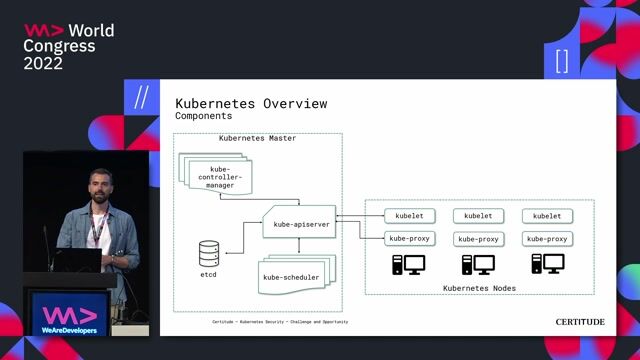
A high-level overview of Kubernetes architecture
The core components of a Kubernetes cluster are explained, including the master node, worker nodes, etcd, API server, and kubelet.
#2about 3 minutes
Configuring workloads with Kubernetes objects
Key Kubernetes objects like pods, deployments, services, and volumes are introduced as the building blocks for configuring applications.
#3about 4 minutes
Managing access with namespaces and admission control
Namespaces are used to group resources, while authentication, authorization, and admission controllers provide granular access control through the API server.
#4about 7 minutes
How container isolation works in the Linux kernel
Containers achieve isolation using Linux kernel features like namespaces and cgroups, but share the host kernel, creating a different security model than VMs.
#5about 2 minutes
Deconstructing a typical Kubernetes cluster attack chain
An attacker can chain exploits, starting from an application vulnerability and escalating to a full container escape and cluster compromise.
#6about 4 minutes
Identifying common Kubernetes security vulnerabilities
Misconfigurations like privileged containers, disabled namespaces, and unpatched software in runtimes like runc create significant security risks.
#7about 6 minutes
Demonstrating a container escape via kernel exploit
A live demo shows how a kernel vulnerability like Dirty COW can be exploited to escape container isolation and gain root access on the host node.
#8about 4 minutes
The risks of RBAC and essential hardening measures
The `create pod` privilege is dangerously powerful, and security can be improved by enabling hardening measures like seccomp profiles and Pod Security Admission.
#9about 4 minutes
Addressing networking and multi-tenancy security challenges
Kubernetes network policies are essential for segmenting traffic, while true multi-tenancy is extremely risky and requires advanced solutions like hardened runtimes.
#10about 1 minute
Leveraging containerization for improved security posture
Despite the risks, containerization offers security advantages through small, understandable workloads that allow for tight security profiles and automated scanning.
#11about 3 minutes
Q&A on managed Kubernetes security in the cloud
The shared responsibility model in cloud Kubernetes services is discussed, highlighting that users must still explicitly enable many hardening features.
Related jobs
Jobs that call for the skills explored in this talk.
Learning Kubernetes made easy with KubeCampusLearning to use Kubernetes? KubeCampus by Kasten offers free educational content for all skill levels to get you started!Kubernetes is an open-source system for deploying, scaling and managing containerized applications. It allows you to deploy your ...
Christina Schaireiter
Why Attend a Developer Event?Modern software engineering moves too fast for documentation alone. Attending a world-class event is about shifting from tactical execution to strategic leadership.
Skill Diversification: Break out of your specific tech stack to see how the industry...
Daniel Cranney
Dev Digest 191: Malware interviews, EU ❤️ Open Source and Skilled AgentsInside last week’s Dev Digest 191 .
💻 Want to write for the WeAreDevelopers Magazine?
⚒️ Claude skills - a less token hungry MCP?
🫰 How much does Cursor spend on AWS?
🧠 LLMs and Brain Rot
🟥 Change your NPM tokens now!
🧑 Fake AI recruiters delivering...