

World Congress 2026 Europe Jul 9, 2026 Session details

Tour de Force: Open-Source LLM Inference Optimization from Simple to Sophisticated

Christin Pohl

Maximizing open-source LLM throughput requires aggressively balancing compute and memory bottlenecks. Master the complete GPU optimization stack, from simple model quantization to sophisticated speculative decoding.

Pause
Mute Enter Fullscreen
#1 about 2 min

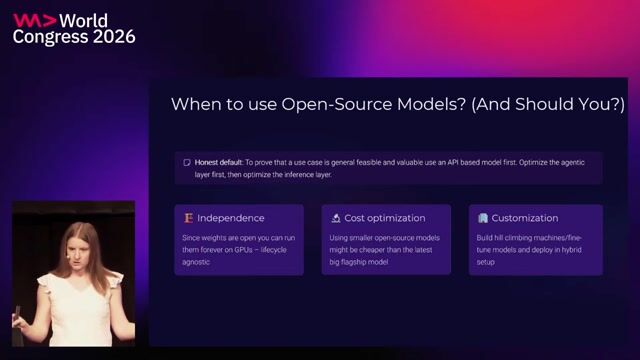
Strategic reasons to adopt open-source inference models

Overcome vendor lock-in and high scaling costs by utilizing independent open-source models for customized agentic scenarios.

#2 about 2 min

Navigating the layers of the language model inference stack

Make open-source models operate efficiently by tuning the underlying infrastructure, framework layers, and dynamic runtime caching systems.

#3 about 3 min

Balancing compute and memory bound inference performance metrics

Balance competing performance indicators by separating compute-heavy initial token generation metrics from memory-bound subsequent latency measurements.

#4 about 3 min

Right-sizing language models for specific agentic use cases

Prevent unnecessary structural bloat by employing leaderboard tracking and custom evaluations to pinpoint correctly scaled language models.

#5 about 2 min

Leveraging quantization to improve memory utilization and throughput

Shrink memory footprints and escalate throughput simultaneously by applying reduced floating point precision to architectural components.

#6 about 2 min

Implementing smart routing and hardcoded intents for cost savings

Cut excessive inference overhead by triaging complex requests and hardcoding responses for simple recurring user greetings.

#7 about 2 min

Enhancing hardware utilization with continuous batching library frameworks

Eliminate idle hardware downtime by substituting static batch configurations with continuous frameworks that constantly process overlapping token sequences.

#8 about 2 min

Improving inference efficiency utilizing cache aware replica routing

Avoid recomputing identical conversational histories by routing recurring agentic prompts toward replicas already storing corresponding cache markers.

#9 about 3 min

Distributing large models effectively across multi-server architectures

Bypass severe hardware limitations by slicing neural network layers sequentially and parallelly across networked multi-gpu virtual machines.

#10 about 3 min

Accelerating token generation speeds with speculative decoding techniques

Resolve slow text production bottlenecks by rapidly projecting probable outputs using secondary draft networks for batch verification.

#11 about 2 min

Advancing efficiency with disaggregated inference and model distillation

Maximize high-volume stability by physically isolating request pre-validation nodes apart from memory-intensive continuous token decoding workers.

#12 about 3 min

Streamlining managed open-source deployments via native cloud resources

Abstract away complex hardware provisioning by integrating pre-optimized managed compute templates designed for broad open-source collections.

#13 about 2 min

Self-hosting distributed inference clusters on orchestrated container services

Achieve granular configuration access by managing custom open-source inference stacks directly over containerized graphic processing clusters.

#14 about 3 min

A structured framework for adopting custom open-source inference

Ensure predictable self-hosted deployments by advancing from defined benchmarks through structured machine learning operation scaling loops.

#15 about 2 min

Optimizing small models for local inference and personal usage

Attain absolute parameter control alongside zero runtime costs by adapting local inference structures toward small-scale personal devices.

Matching moments

2:39 min

Open source tools for running and scaling models

Cedric Clyburn Cedric Clyburn +1 · World Congress 2025

3:30 min

Optimizing performance using dedicated open source inference engines

Patrick Koss Patrick Koss · World Congress 2025

1:47 min

Managing compute costs and AI model routing

Deivids Vilkinsons Deivids Vilkinsons +3 · World Congress 2026 Europe

1:52 min

Prioritizing developer user experience over raw model parameters

Neel Sundaresan Neel Sundaresan +1 · World Congress 2026 Europe

1:45 min

Introduction to serving large language models locally

Patrick Koss Patrick Koss · World Congress 2025

3:11 min

Optimizing inference costs through efficient distributed runtimes

Anshul Jindal Anshul Jindal +1 · World Congress 2026 Europe

Upcoming sessions on this topic

Open session

World Congress 2026 North America

September 24, 2026 · 16:10–16:40

Stage 9

Fast, Cheap, and Accurate: Optimizing LLM Inference with vLLM and Quantization

Legare Kerrison, Cedric Clyburn

Legare Kerrison
Cedric Clyburn
Open session

World Congress 2026 North America

September 23, 2026 · 10:45–12:45

Stage 10

Agents That Own Their Inference: Building Production AI Agents on Dedicated GPUs

Duan Lightfoot

Sr. AI Engineer, Akamai

Duan Lightfoot
Open session

World Congress 2026 North America

September 25, 2026 · 13:30–14:00

Mainstage

A Hands-On Developer Guide to Inference Engineering

Ankit Patel, Philip Kiely

Ankit Patel
Philip Kiely
Open session

World Congress 2026 North America

September 24, 2026 · 13:30–14:00

Stage 9

Understanding LLM Architectures: Inside the Design of Modern Models

Jofia Jose Prakash

Director - AI & Governance at Humanity + AI, Inc

Jofia Jose Prakash
Open session

World Congress 2026 North America

September 24, 2026 · 17:30–18:00

Stage 6

No Single Model to Rule Them All: Building Resilient AI Agents Across Open & Closed LLMs

Emmanuel Acheampong

Senior Manager Developer Relations at Crusoe AI

Emmanuel Acheampong
Open session

World Congress 2026 North America

September 24, 2026 · 14:10–14:40

Stage 1

Anatomy of an AI Request: Where Latency and Cost Are Really Born

Dan Fu

VP of Kernels at Together AI

Dan Fu